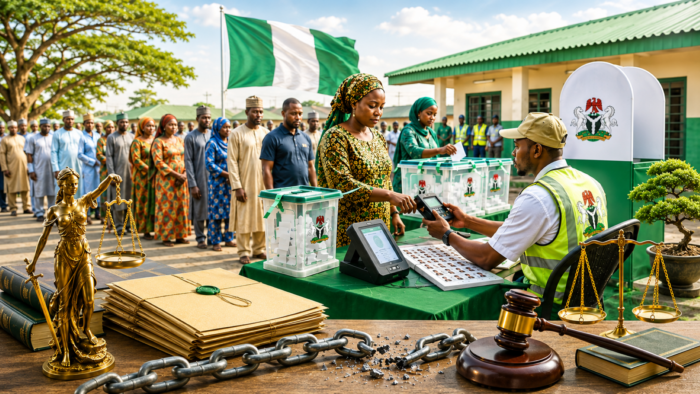
As Nigeria prepares for another election cycle, renewed concerns have emerged over the technical and institutional reforms required to ensure elections are not only free and fair but also credible and widely accepted by citizens.
Political analysts and election experts have emphasized that the credibility of elections remains central to democratic stability, arguing that without transparent and trustworthy electoral processes, public confidence in government institutions may continue to decline.
Observers note that credible elections depend on a combination of effective systems, reliable technology, strong institutions, transparency, and accountability throughout the electoral process.
Over the years, the Independent National Electoral Commission (INEC) has introduced several technological innovations aimed at improving election credibility, including the Bimodal Voter Accreditation System (BVAS) and the INEC Result Viewing Portal (IReV).
These tools were designed to strengthen voter accreditation, reduce electoral fraud, and improve transparency in result management. However, experts argue that technology alone cannot guarantee credible elections without addressing deeper institutional and operational challenges.
According to analysts, countries with strong democratic traditions, including the United Kingdom, Canada, and Germany, have built reliable electoral systems through accurate voter registers, secure voting procedures, transparent result collation, and effective mechanisms for resolving electoral disputes.
They believe Nigeria must strengthen similar areas by improving voter registration systems, ensuring secure accreditation processes, creating clear audit trails during result collation, and guaranteeing timely and impartial resolution of election disputes.
Despite ongoing reforms, several challenges continue to affect public confidence in Nigeria’s electoral process.
One major concern is the integrity of the voter register, with issues such as duplicate registrations, incomplete records, and allegations of underage voting continuing to generate controversy.
Logistical challenges also remain a major obstacle, as delays in the delivery of election materials, malfunctioning equipment, and inadequate training of election officials have contributed to concerns about the efficiency and reliability of elections.
Security challenges have also affected electoral activities in some parts of the country, with reports of intimidation, violence, and disruption of voting processes threatening peaceful participation.
Another area of concern is the management and transmission of election results. Delays, technical difficulties, and inconsistencies in uploading results have often created suspicion among voters and political parties, reducing trust in declared outcomes.
The slow pace of resolving election disputes through the courts has also been identified as a challenge, with lengthy legal battles sometimes extending beyond the period when elected officials assume office.
Experts argue that Nigeria must adopt a comprehensive approach to electoral reform by combining technology, institutional strengthening, effective planning, and greater involvement of stakeholders.
They recommend that electoral reforms should focus on improving voter registration through biometric verification, regular database audits, and integration with other national identity systems.
They also emphasize the need for better preparation of election officials, improved logistics management, and stronger contingency plans to address technical and operational failures during elections.
Security agencies, according to analysts, must maintain neutrality and focus on protecting voters, electoral officials, and election materials rather than influencing electoral outcomes.
Transparency in result management has also been identified as a critical requirement. Experts insist that systems such as BVAS and IReV must be supported with reliable backup mechanisms to prevent technical failures from affecting public confidence.
They further advocate reforms in electoral justice, arguing that election-related disputes should be resolved faster to ensure that judicial decisions are delivered before prolonged uncertainty affects governance.
Beyond institutional reforms, experts stress the importance of continuous civic education to ensure that citizens understand their rights and responsibilities during elections.
They argue that voters, civil society organizations, and the media all have important roles to play in protecting electoral integrity.
According to observers, citizens must reject vote buying, report irregularities, and actively participate in monitoring electoral processes, while civil society groups should continue documenting challenges and advocating for transparency.
The media, they say, must also maintain professionalism by providing accurate information and avoiding the spread of misinformation that could increase tension during elections.
Analysts have also highlighted the importance of maintaining a balance between technology and traditional electoral safeguards.
While digital tools can improve transparency and efficiency, they argue that physical verification systems and manual backup procedures remain necessary to ensure resilience when technology fails.
Countries such as India and the United States have demonstrated the importance of combining technological solutions with manual oversight mechanisms to strengthen election security and reliability.
Another key issue identified is the independence and capacity of electoral institutions. Experts maintain that INEC must be adequately funded, professionally staffed, and protected from political interference to effectively perform its constitutional responsibilities.
They argue that stronger partnerships between electoral institutions, civil society organizations, and international stakeholders can help improve oversight and build greater public confidence.
As Nigeria moves closer to future elections, stakeholders insist that credible elections must be treated as a continuous process rather than an activity limited to election periods.
They maintain that building a trusted electoral system requires long-term commitment, institutional reforms, citizen participation, and consistent improvement based on lessons from previous election cycles.
With effective reforms and stronger democratic institutions, analysts believe Nigeria can achieve elections that reflect the true choices of citizens and strengthen confidence in the country’s democratic journey.